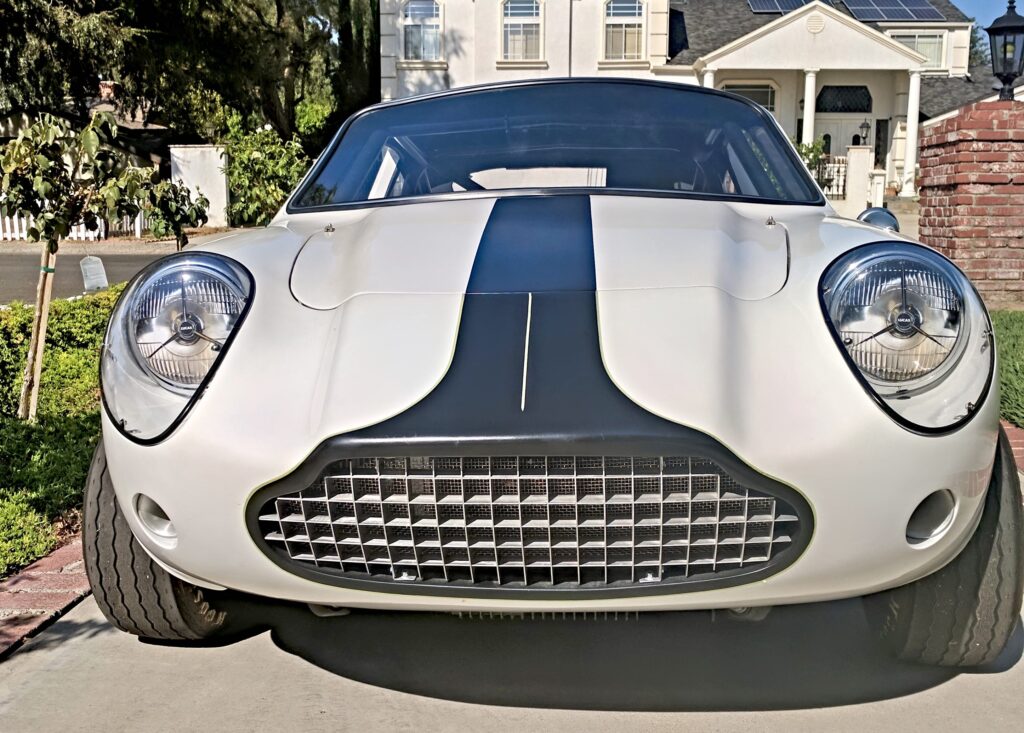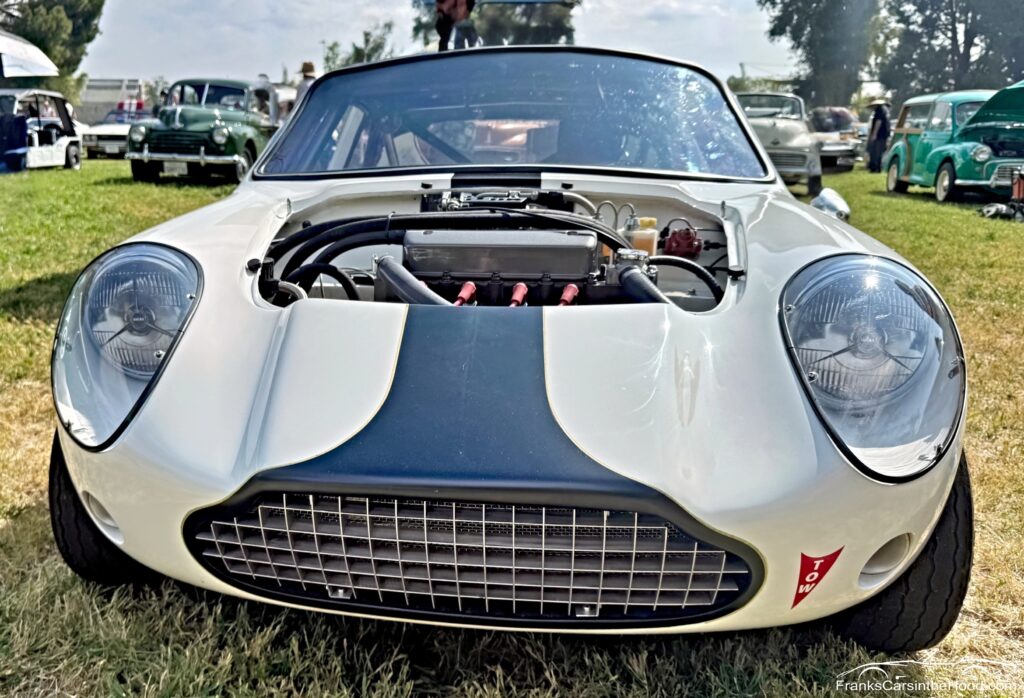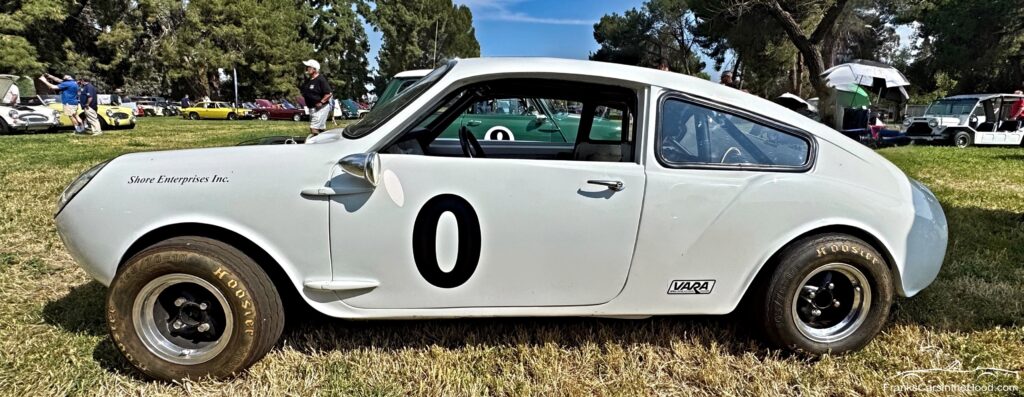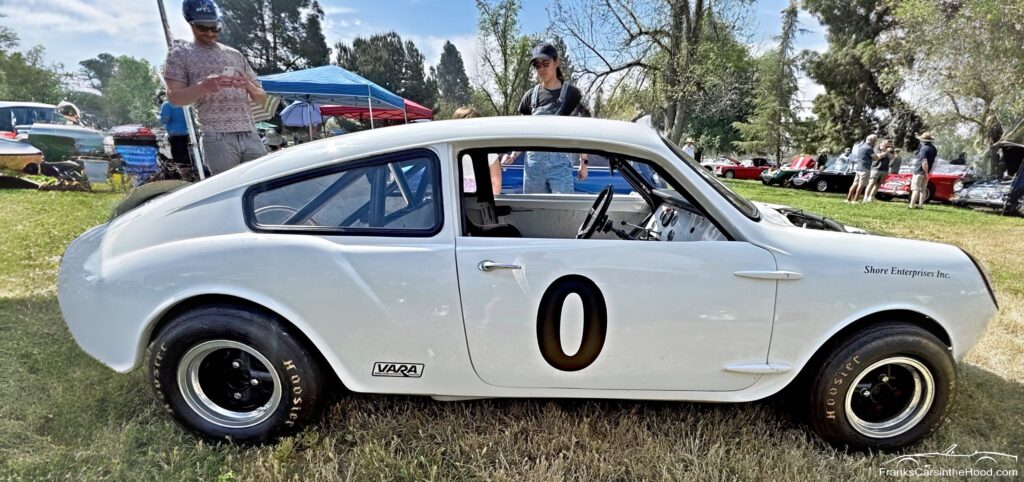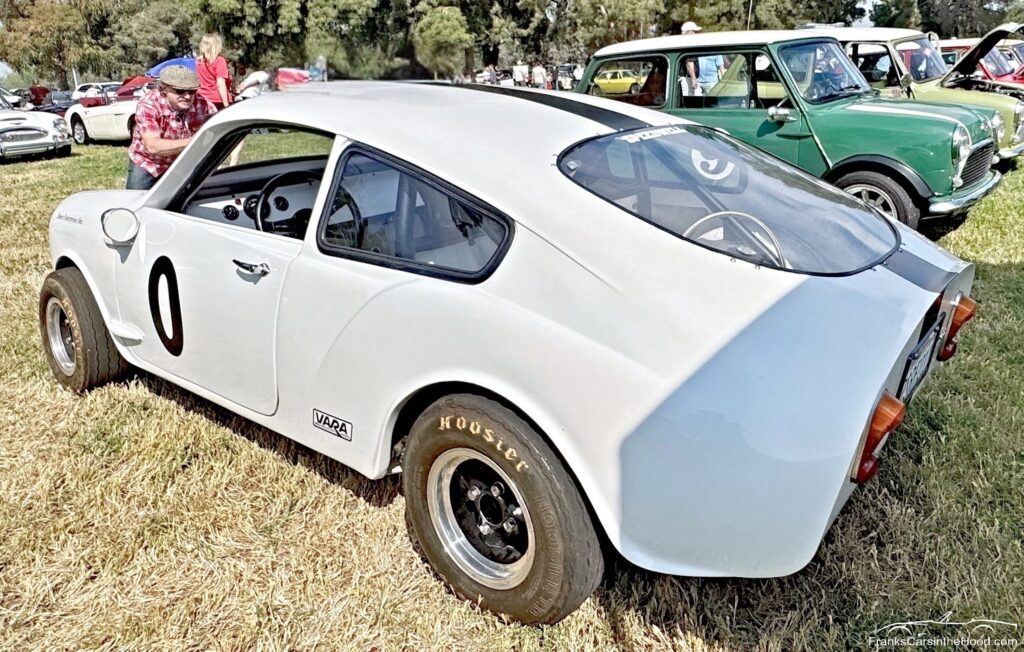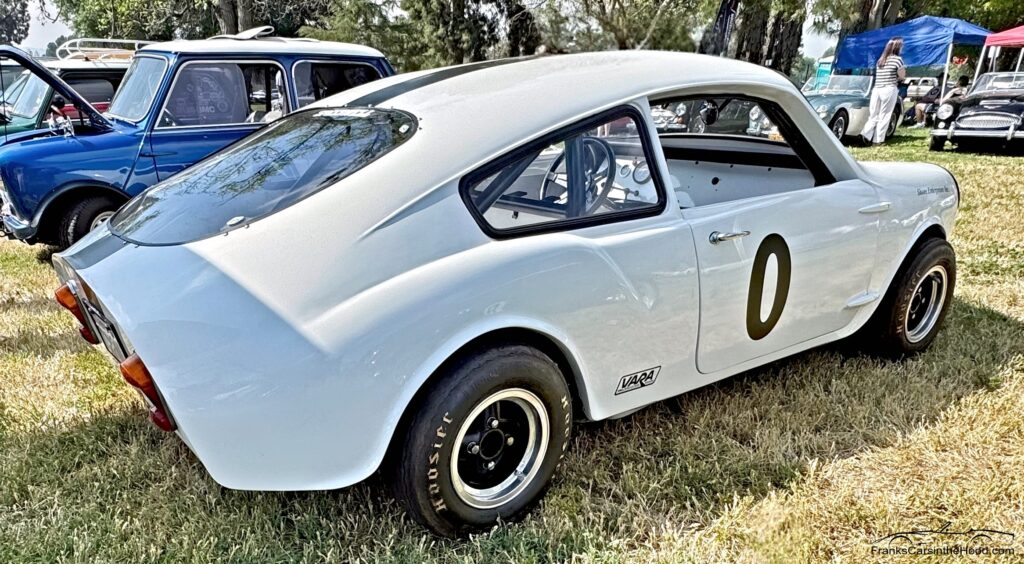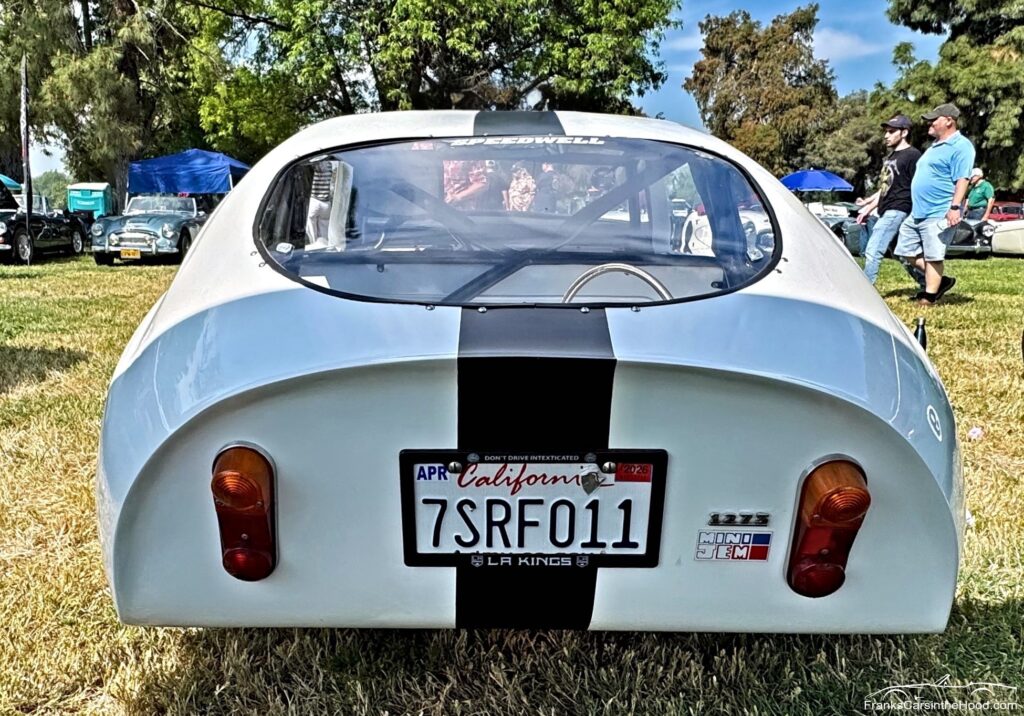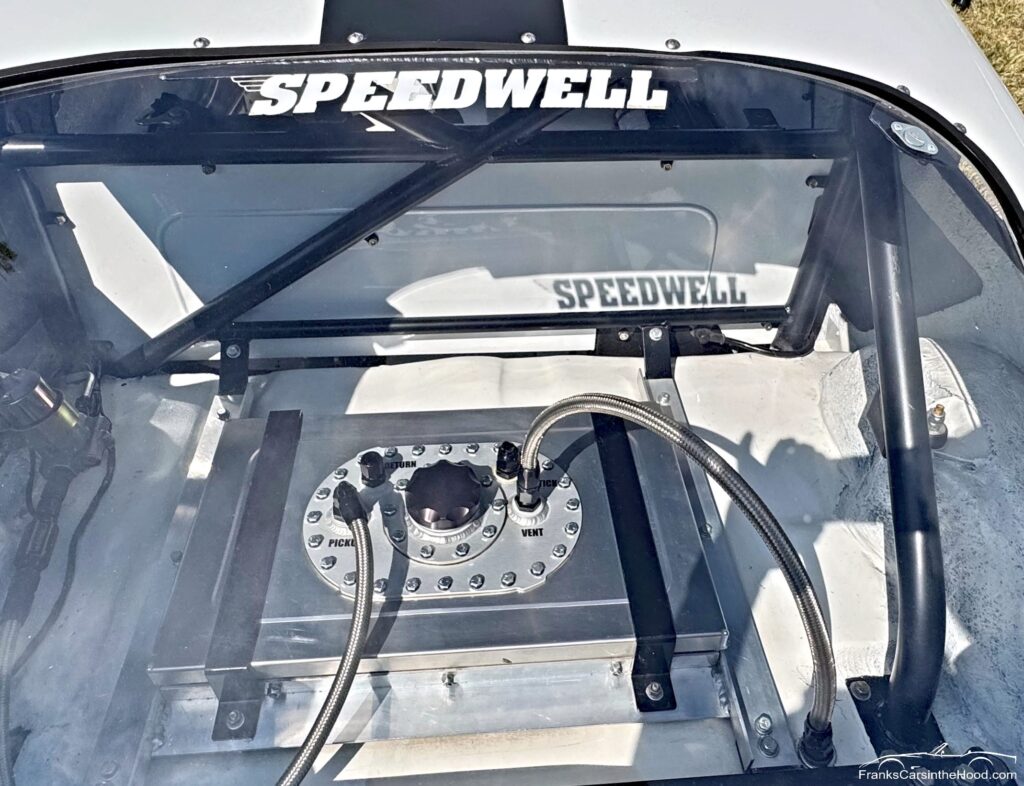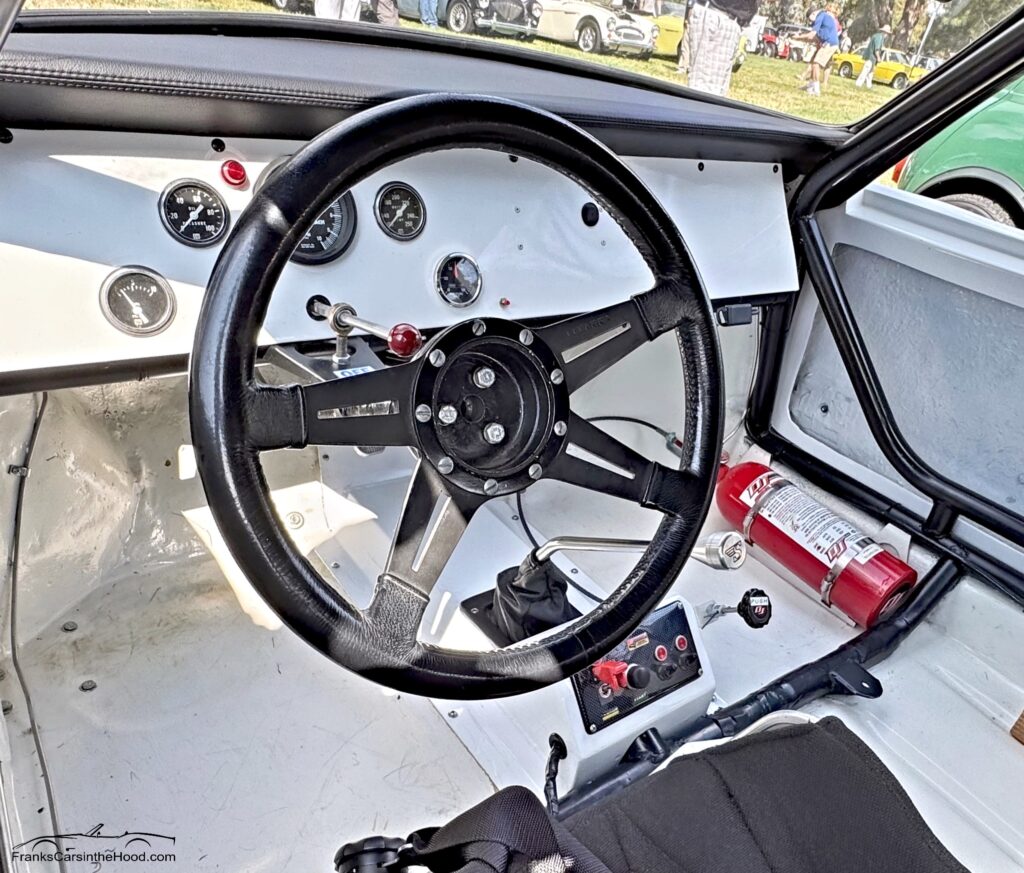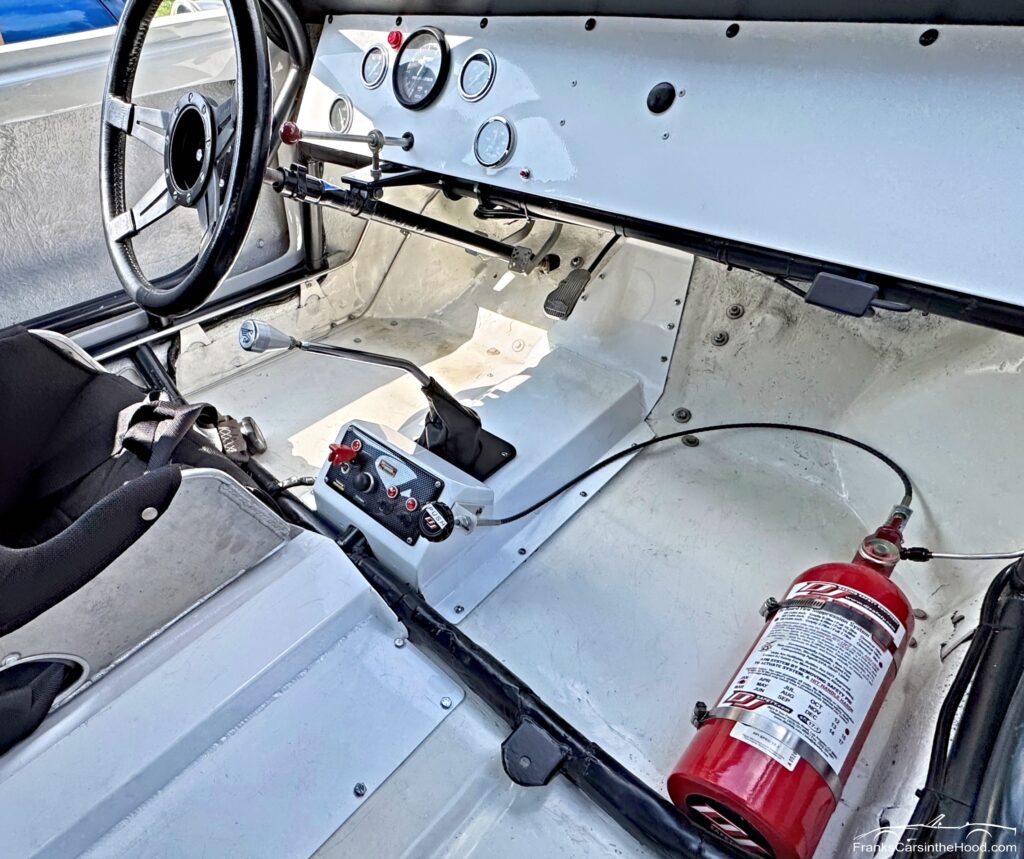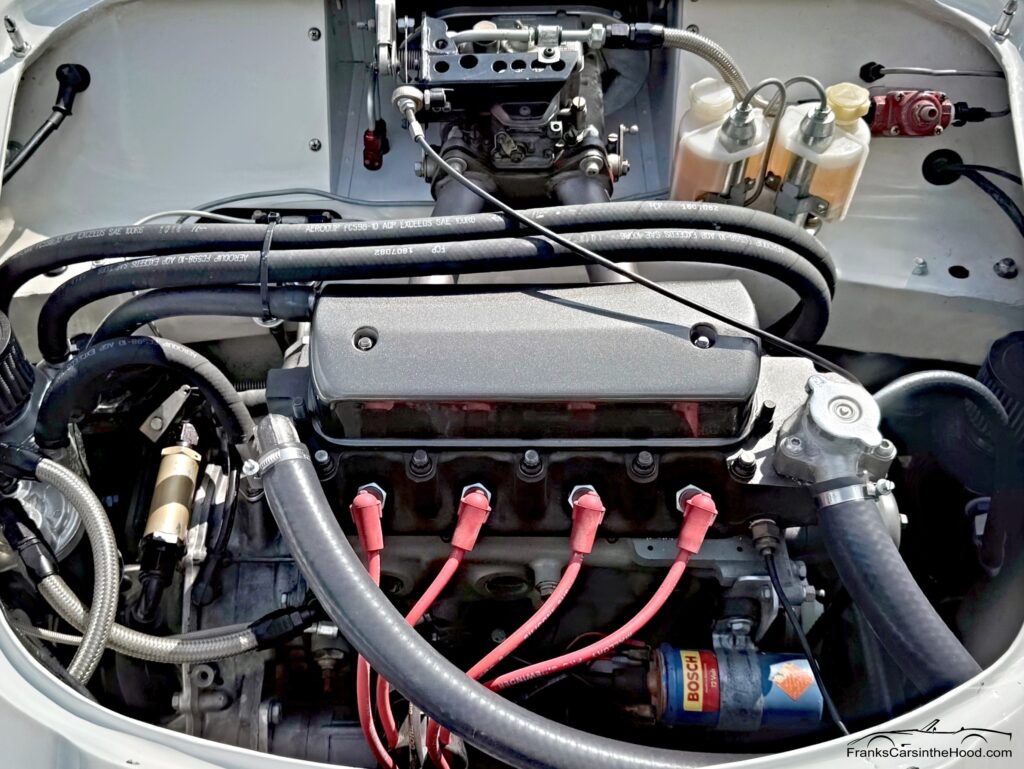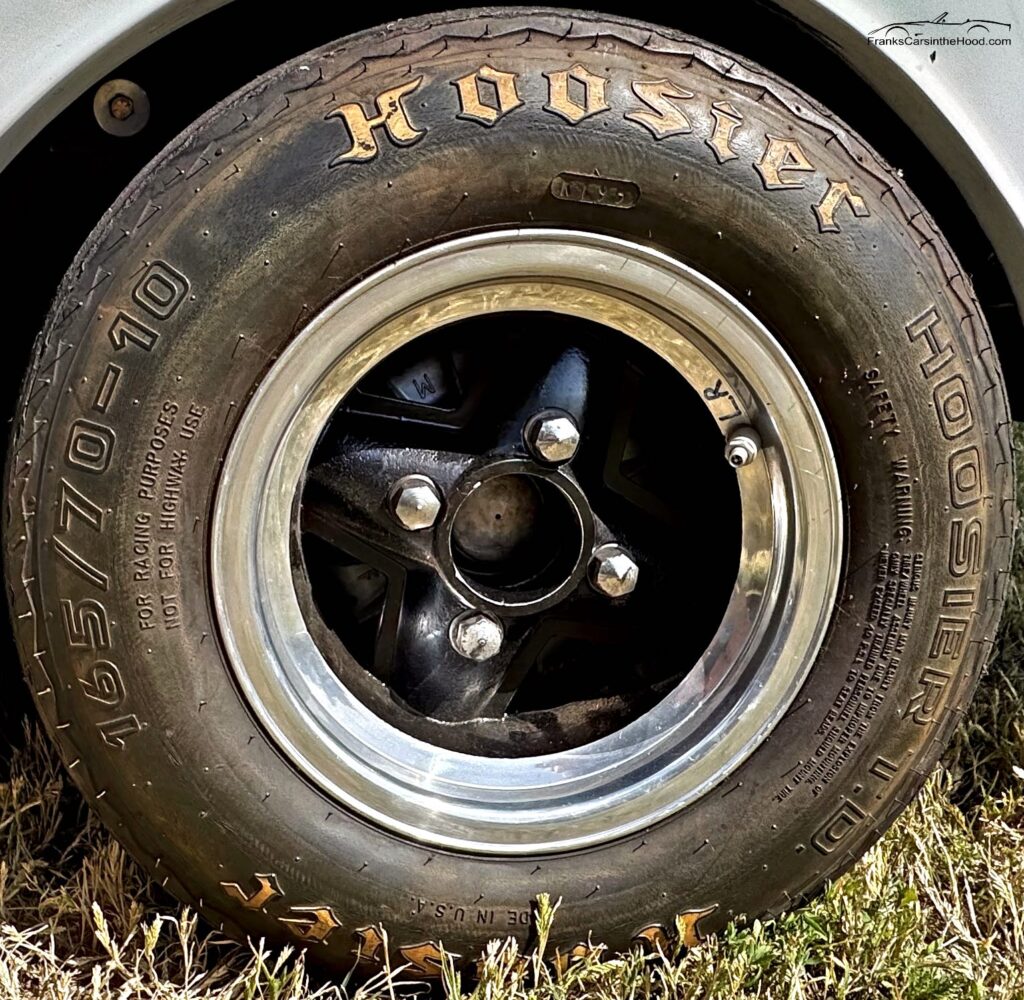
Today’s car is a 1965 Mini Jem race car owned and built by Dale Shore, which I photographed at the 18th Annual Queen’s English All British Car Show 2026 at Woodley Park in Van Nuys, CA. It’s finished in white, with a painted interior, a black racing seat, a black roll cage built by Tom Colby, and only the essential equipment needed for racing. It is powered by a race-built British Motor Corporation (BMC) A-Series inline four-cylinder OHV engine, originally 1275cc and offset bored to 1380cc, producing in excess of 120 horsepower, and equipped with a Weber 45 DCOE carburetor, mated to a Jack Knight 4-speed manual straight-cut close-ratio gearbox mounted transversely with a limited-slip differential and a 3.90:1 final drive ratio. Braking is handled by slotted and cryogenically treated front disc brakes with Mini spares alloy four-piston calipers and Minifin rear drums, consistent with a performance-oriented Mini setup. The suspension retains the Mini’s Moulton rubber cone design, upgraded with Hi/Lo ride height adjusters at all four corners, allowing the stance to be dialed in precisely, with adjustable camber and caster arms up front and KAD camber and toe adjustments in the rear, giving the car a level of suspension tuning well beyond a standard Mini. Unlike a standard Mini, the Jem features a lightweight fiberglass body, significantly reducing weight and improving performance, and even standing still, its low stance, short wheelbase, and compact proportions give it a purposeful, competition-inspired look that reflects its racing roots.
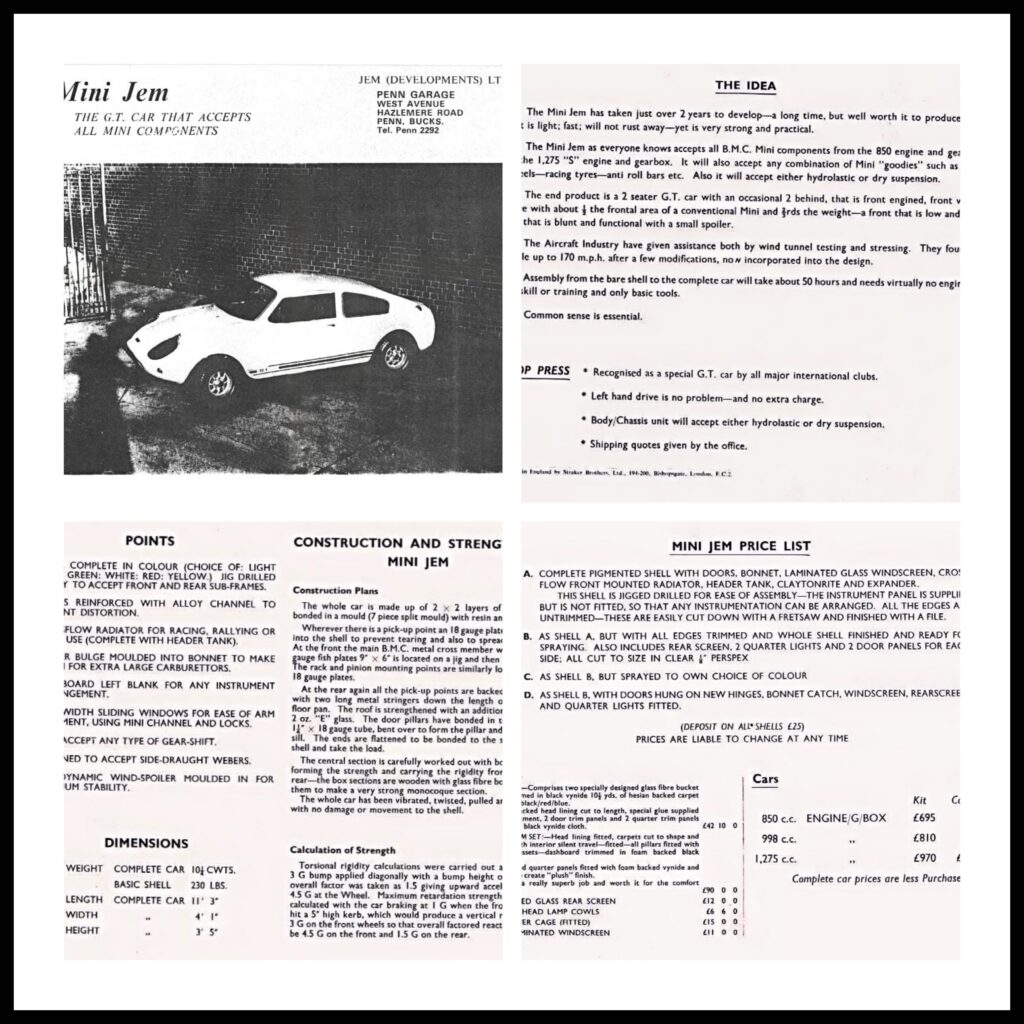
The story of the Mini Jem begins not with a company, but with an idea. In the early 1960s, British engineer and test pilot Desmond Addicott, known as “Dizzy,” set out to improve the Mini’s performance through aerodynamics. Starting with a Morris Mini Van, he created a streamlined, steel-bodied prototype known as the Mini DART, applying aerodynamic principles to reduce drag and improve high-speed stability.
The DART proved the concept. Its shape was refined and eventually adapted into fiberglass form, leading to a small number of early shells produced as the project gained interest. As often happened with low-volume British specials of the period, the project evolved through different hands. Following a split in development, the design was ultimately taken forward by Jeremy Delmar-Morgan, who marketed the car as the Mini Jem through Jem Developments.
Following the early development of the Jem, similar concepts were already taking shape, most notably with the Mini Marcos, which shared similar aerodynamic principles and Mini-based mechanicals. Together, these cars represent a unique branch of Mini evolution, where independent builders pushed the limits of performance through lightweight construction and improved aerodynamics.
The Mini Jem carried forward the core idea of improving Mini performance through reduced weight and better aerodynamics. Using a lightweight fiberglass body mounted over Mini mechanicals, the Jem retained the original car’s compact footprint while significantly lowering overall weight.
These cars were typically offered as kits or low-volume builds, allowing owners to transfer components from donor Minis, particularly as older steel-bodied cars began to deteriorate from rust, while also providing a lighter and more aerodynamic platform better suited for racing and performance use.
The result was a car that maintained the Mini’s well-known agility but delivered improved acceleration and efficiency, making it especially well-suited for competition and enthusiast builds.
Production of the Mini Jem remained limited, reflecting the small-scale nature of British specialty car manufacturing in the mid-1960s. Following the development of the original DART concept, early fiberglass production of the Jem is generally estimated to have totaled around 100 cars, making it a relatively rare example of the period.
With its lightweight fiberglass body and improved aerodynamics over the standard Mini, the Jem represented an early step in the evolution of Mini-based performance specials. Similar concepts had already emerged, most notably the Mini Marcos, which carried the idea further and brought wider recognition to the lightweight, aerodynamic Mini-based design.
Dale’s connection to this 1965 Mini Jem spans decades. The car began as a rolling shell that had been sitting under a tree for years, eventually making its way to a Vintage Auto Racing Association (VARA)-connected owner who never completed the project. When Dale had the opportunity, he purchased the car and placed it into storage, where it remained for roughly 25 years.
Eventually, the decision had to be made. Rather than let it continue to sit, Dale chose to move forward and build the car into something purposeful.
This wasn’t a restoration. Dale built the car as a race car from the ground up, using many of the components from his own Mini race program, represented under the name Shore Enterprises Inc. The body remained, but nearly everything else was reworked or replaced to suit its intended use.
What sets the car apart is not just the drivetrain, but the body itself. Compared to the upright, box-like shape of a standard Mini, the Jem’s lightweight fiberglass body offers improved aerodynamics. On track, that difference is measurable. With essentially the same drivetrain as his race Mini, the Jem runs approximately 500 RPM higher on the straightaways, nearly a second per lap faster.
Now completed and sorted, the car has seen time on track, including an outings at Willow Springs, where its lightweight design and aerodynamic advantage are immediately apparent.
Standing there, this beautifully built, Mini Jem stands apart from a standard Mini. Smaller, lighter, and more focused, it reflects a time when performance gains came not just from horsepower, but from ingenuity and weight reduction. It would be at home at any British car show, vintage racing event, drawing interest at a local Cars & Coffee, or carving through a winding canyon road in the Santa Monica Mountains where its lightweight design and sharp handling can truly be appreciated.
Thanks for riding along.
Frank