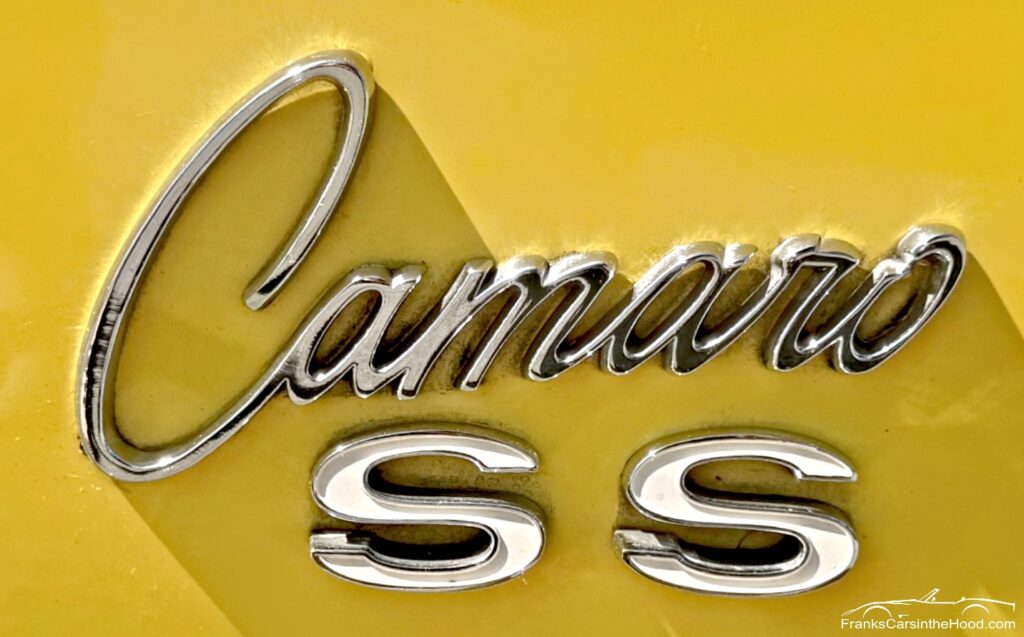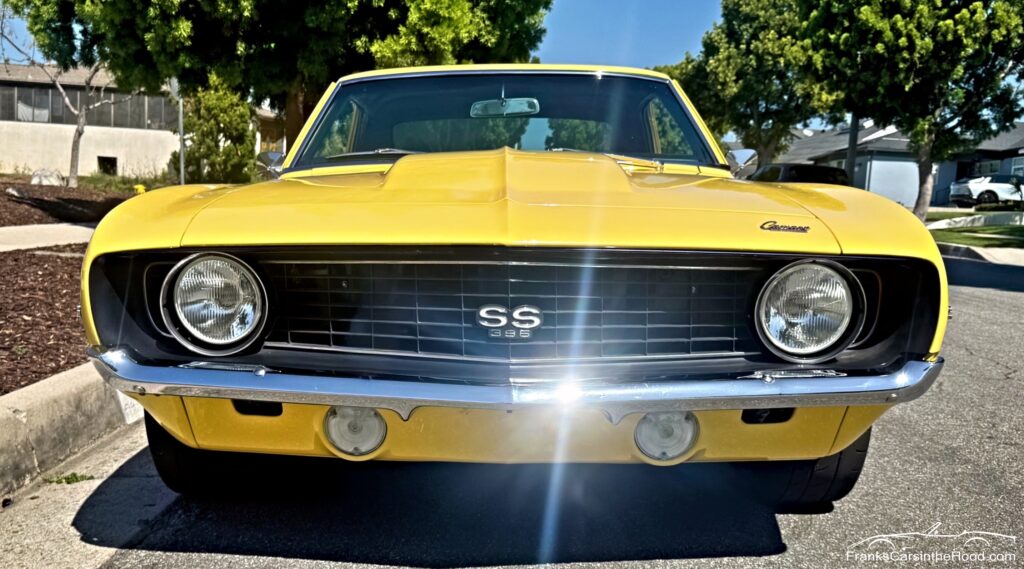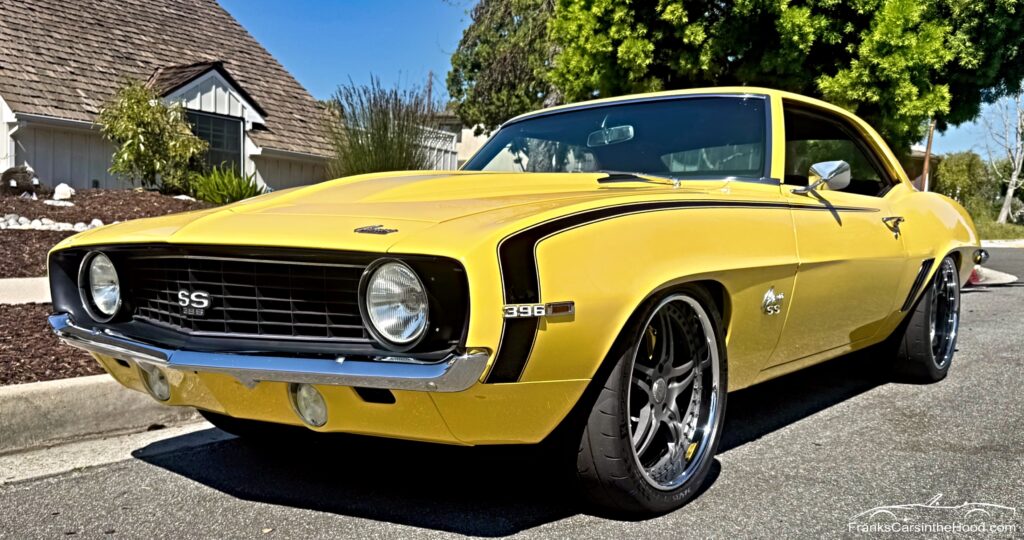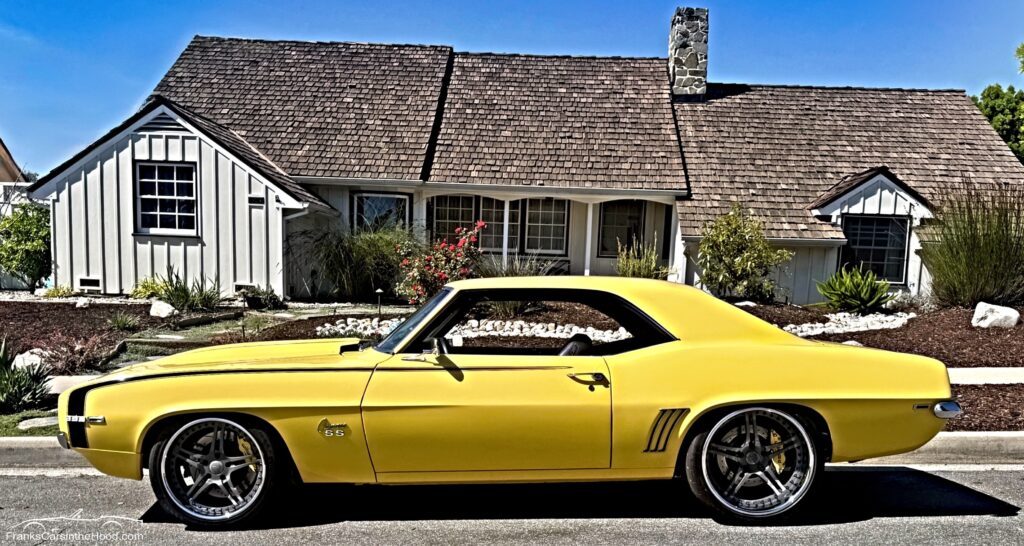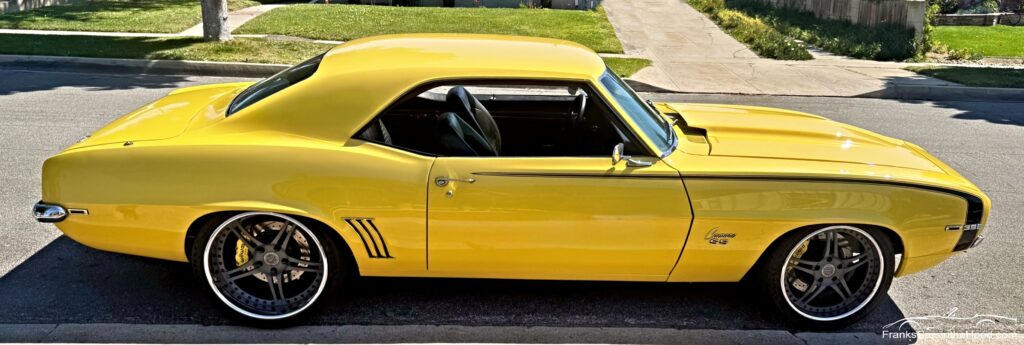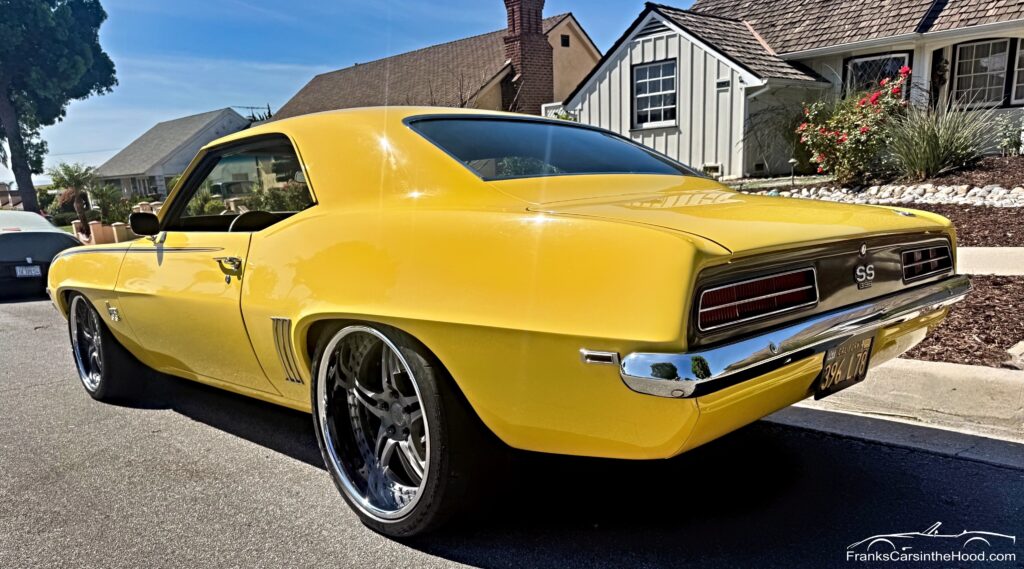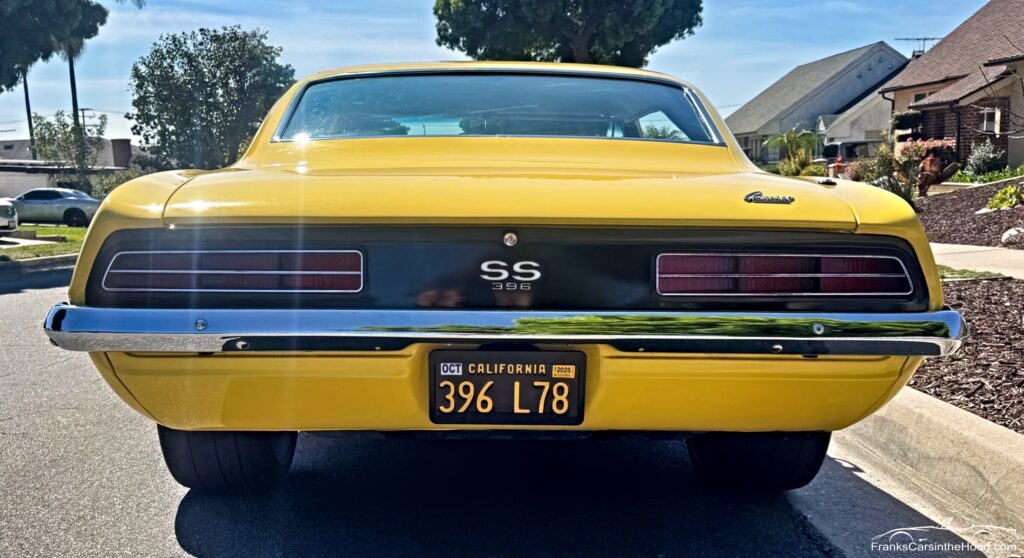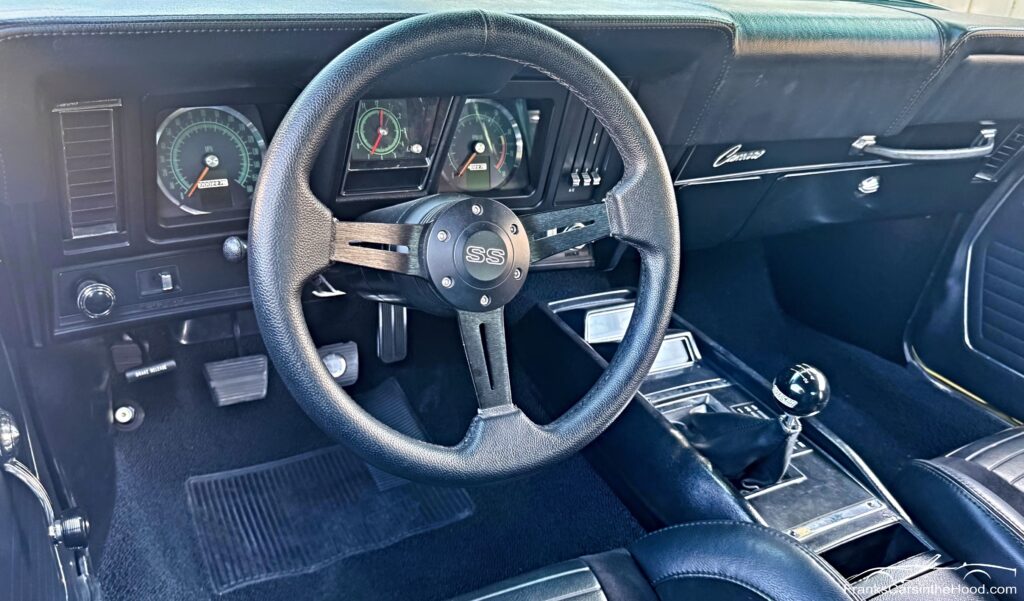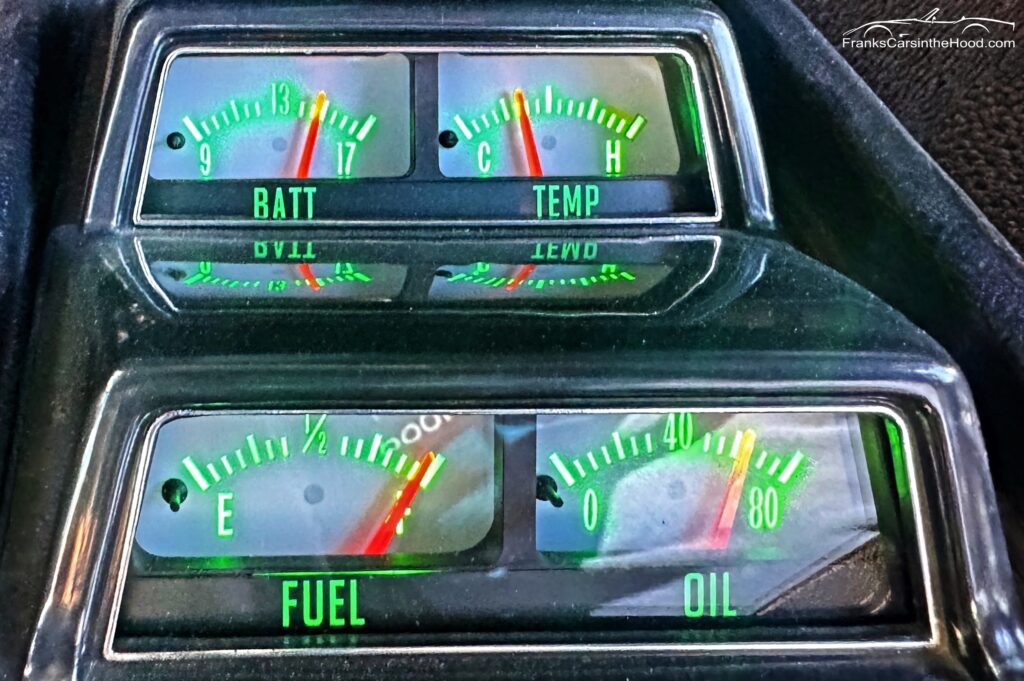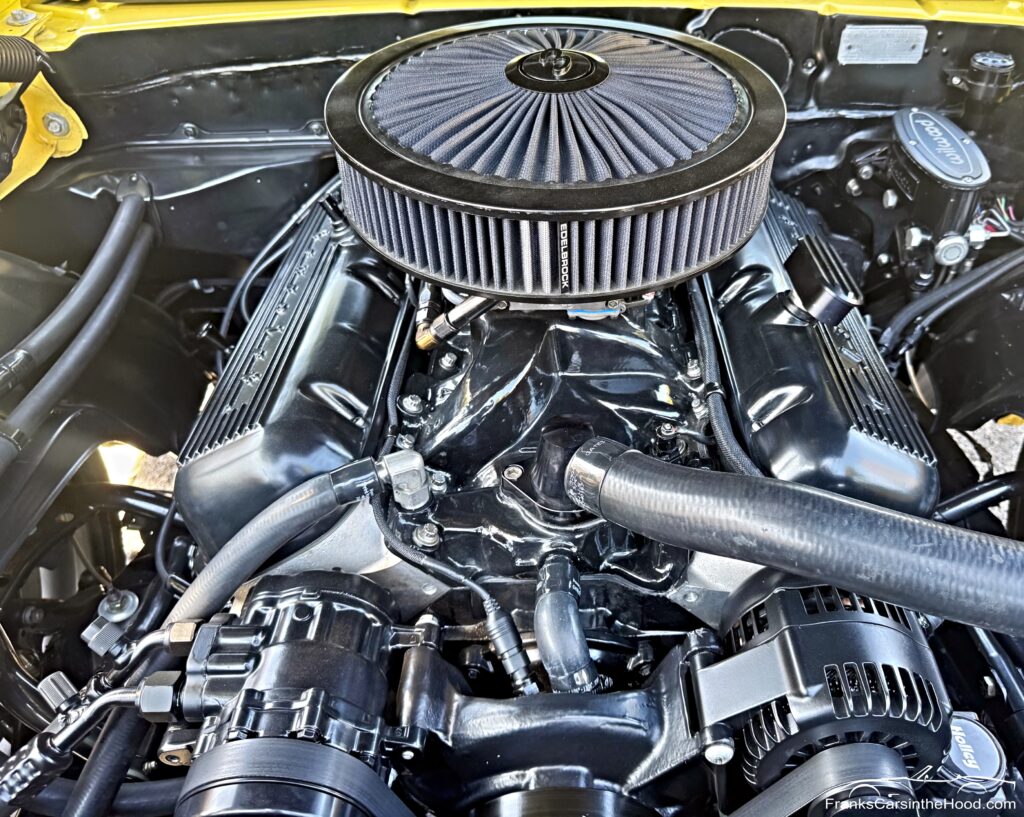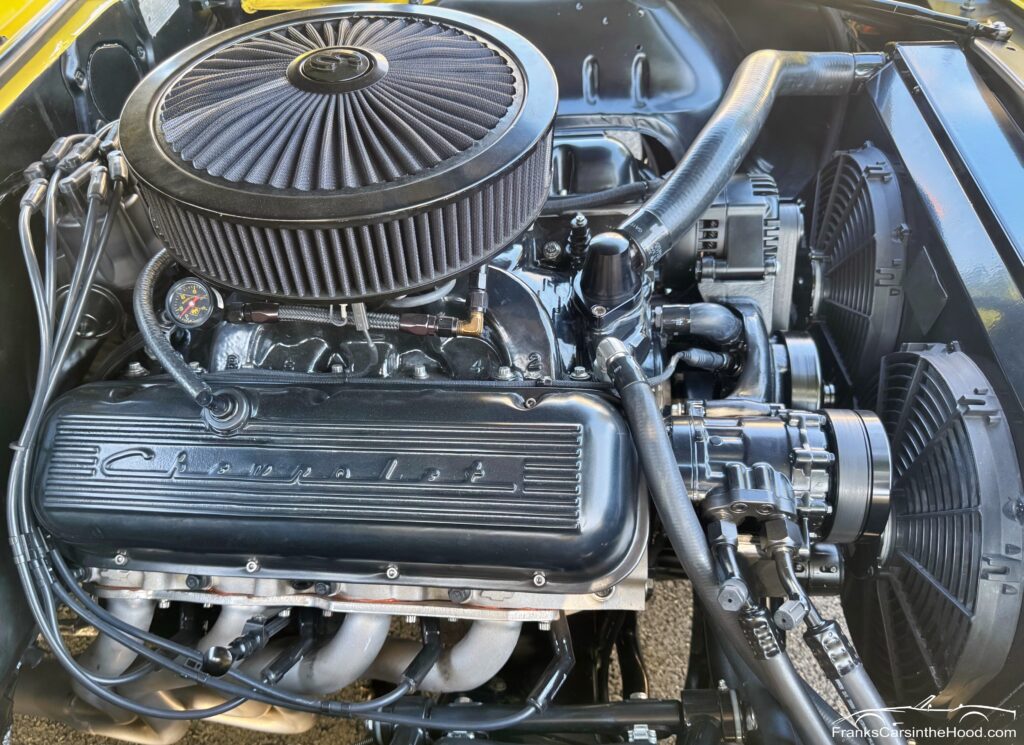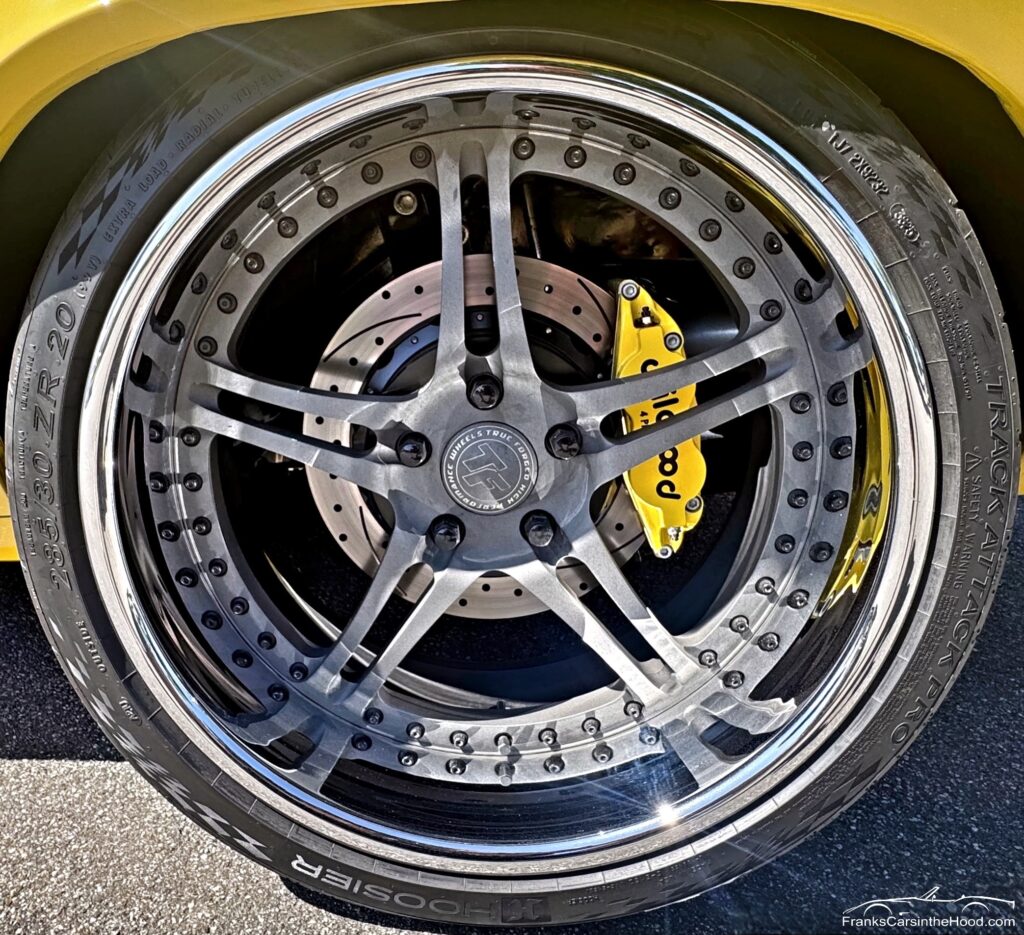
Today’s car is a 1969 Chevrolet Camaro owned by Ronnie Smith, which I photographed at his home after a Net Cruze Cars & Coffee event held at the Ladera Senior Citizen Center in Los Angeles, CA. It’s finished in its original factory Daytona Yellow with black stripes and a black interior. It was originally equipped with the L78 396 cubic inch big-block V8 rated at 375 horsepower, one of Chevrolet’s top performance engines for the Camaro in 1969. Today, it is powered by a Chevrolet Performance ZZ502 crate engine, a 502 cubic inch big-block V8 with a full roller valvetrain, a Holley carburetor, and a more street-friendly 9.0:1 compression ratio, replacing the original high-compression 12.5:1 engine that required race fuel. It is mated to a Tremec TKX 5-speed manual transmission, while the original 12-bolt Positraction rear axle remains in place with a 3.73:1 gear ratio. Braking is handled by Wilwood four-wheel disc brakes, with six-piston calipers in the front and four-piston calipers in the rear, all in a manual (non-power) configuration. The suspension consists of independent front suspension with coil springs and control arms, and a rear live axle with semi-elliptic leaf springs. The car is equipped with power steering, Vintage Air air conditioning, and Dakota Digital gauges, blending modern drivability with a largely stock appearance. It sits on True Forged 19-inch wheels up front and 20-inch wheels in the rear, wrapped in Hoosier TrackAttack Pro tires, giving the car a more aggressive stance and the grip to match its big-block power.
Even standing still, the 1969 Camaro has an unmistakable presence. The long hood, short deck proportions, deep-set grille, and sharply defined body lines give it a muscular, aggressive stance that represents the peak of first-generation Camaro design.
Chevrolet was founded in 1911 by Louis Chevrolet and William C. Durant and quickly became one of the core divisions of General Motors. By the mid-1960s, Chevrolet had established itself as a leader in the American automotive market, producing everything from economical compact cars to mid-size performance machines and full-size cruisers, with the Corvette carrying the performance banner for the brand. One thing was missing from the lineup, a direct competitor to Ford’s wildly successful Mustang, a gap that would soon be filled by the Camaro.
The Camaro was developed under the direction of General Motors design chief Bill Mitchell, with production design led by Henry Haga. Mitchell’s influence can be seen in the Camaro’s clean, aggressive lines, which borrowed cues from other GM performance cars of the period, including the Corvette. For 1969, the Camaro received a significant redesign while remaining part of the first generation, with sharper creases, a more pronounced grille, and a wider, more planted stance that gave the car an even more aggressive and performance-oriented look.
Introduced in September 1966 for the 1967 model year, the Camaro was Chevrolet’s direct response to the Mustang and the emerging “pony car” market. It offered a wide range of configurations, from basic transportation to serious high-performance machines. By 1969, the Camaro had reached the most refined stage of its first-generation development, with offerings including the RS, SS, and Z/28 packages. The Z/28, developed for SCCA Trans-Am racing, featured a high-revving 302 cubic inch V8 and improved handling, making it one of the most balanced performance cars of the era. Today, the 1969 Camaro is widely regarded as the most desirable of the first-generation cars, combining aggressive styling with a broad range of performance options.
Chevrolet produced a total of 699,138 first-generation Camaros between 1967 and 1969, with 243,085 built for the 1969 model year alone, making it the highest production year of the first generation. Within that total, approximately 34,932 cars were equipped with the SS396 package, with an estimated 4,889 fitted with the L78 396 cubic inch V8 rated at 375 horsepower, the same high-performance configuration that Ronnie’s car originally carried. In 1969, the base MSRP for a Camaro Sport Coupe started at approximately $2,727, with the SS396 package adding about $416. A properly equipped L78 Camaro typically reached the mid-$3,500 range when new. Performance for the L78 was strong for its time, with 0–60 mph times in the low 6-second range and top speeds approaching 130 mph depending on gearing and setup.
Ronnie’s connection to this 1969 Camaro began long before he became its owner. The car originally belonged to a close friend who had taken on a full build, bringing the project to roughly 70 percent completion before it stalled. For about six years, Ronnie stored the car while it sat unfinished. When the opportunity came to purchase the car, Ronnie stepped in and took ownership and essentially started from scratch. This wasn’t just a matter of finishing a project. He took the car apart, removed the subframe and had it repowder coated, then built it back up the right way, upgrading and finishing it to his standards and taste.
Much of the assembly was handled by Ronnie, while final electrical work and system integration were completed with the help of his friend Dishan Chaudhuri of DC Hot Rods, who handled the wiring, installed the Vintage Air system, and got the car running.
Inside, Ronnie upgraded the interior with TMI seats, offering improved comfort and support over the original design. The car was also briefly converted to a Holley Sniper electronic fuel injection system, but Ronnie ultimately returned to a traditional Holley carburetor setup, preferring the simplicity and familiarity of a more conventional approach.
Now on the road for two years, the Camaro has already earned multiple trophies, a reflection of the quality of the build and Ronnie’s attention to detail throughout.
Standing there, this Camaro is very hard to ignore. The Daytona Yellow paint tends to draw attention, and Ronnie will tell you it also brings a fair amount of good-natured criticism. Some even question how a yellow Camaro manages to take home trophies.
All kidding aside, this car speaks for itself. With its roots in the L78 396, one of the highest-performance factory engines available in 1969, and finished in a color that refuses to blend into the background, it stands out for all the right reasons. It’s clean, well thought out, and built with a clear vision, blending original character with modern performance where it matters most.
It would be at home at any muscle car show, drawing a crowd at a local Cars & Coffee, or stretching its legs on a cruise up the Pacific Coast Highway, where you can hear it before you can see the brilliant blur of yellow.
Thanks for riding along.
Frank