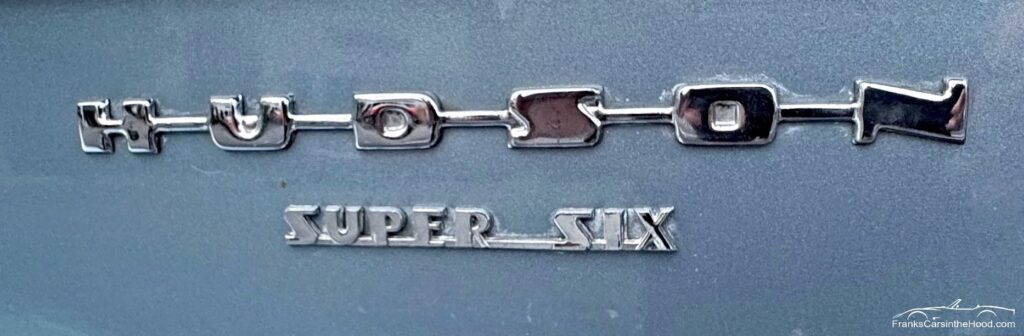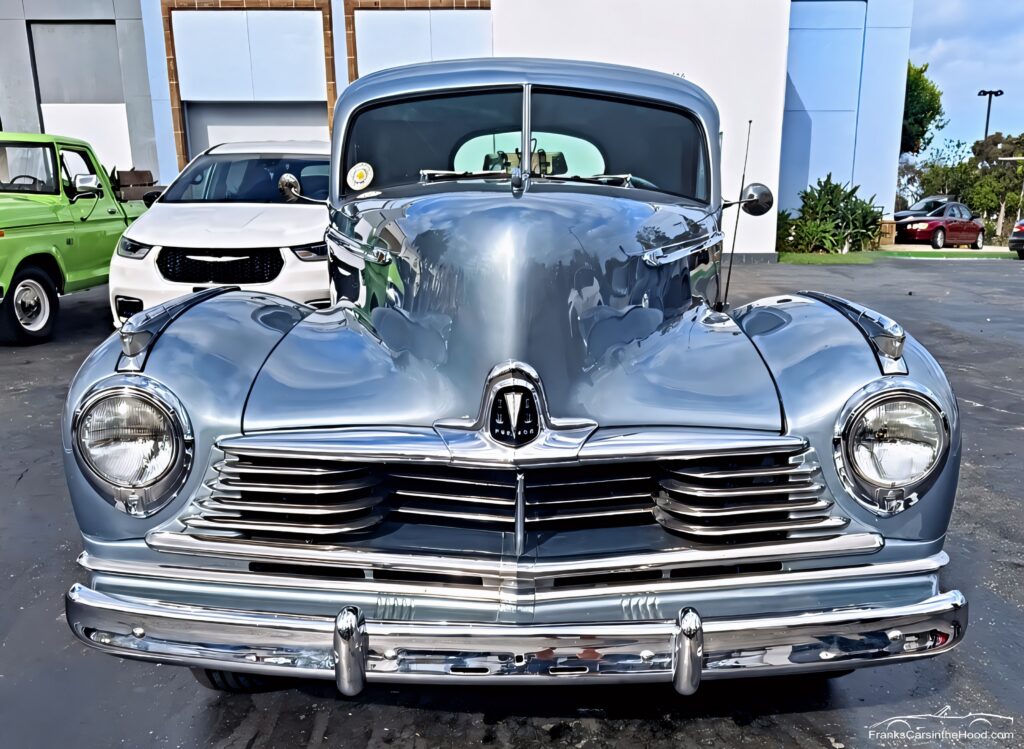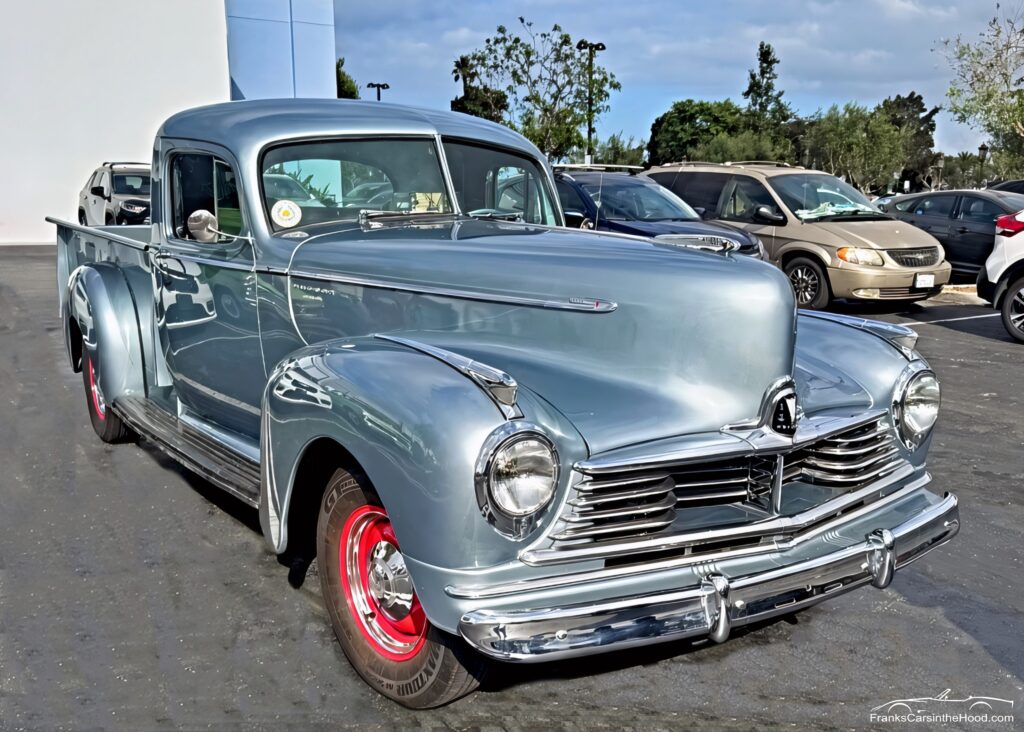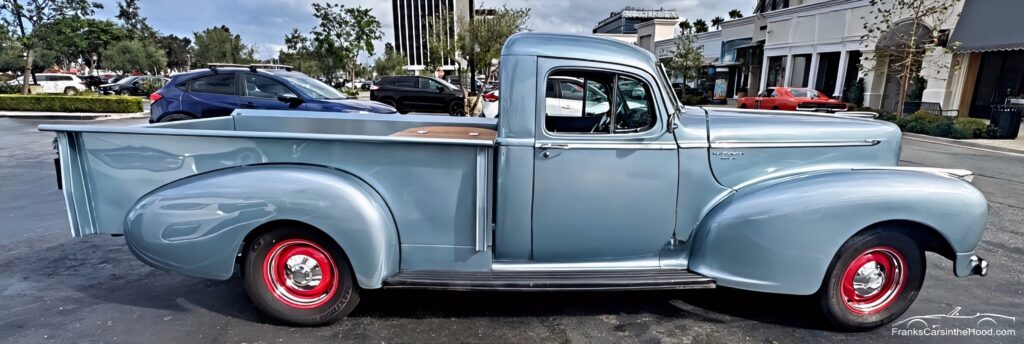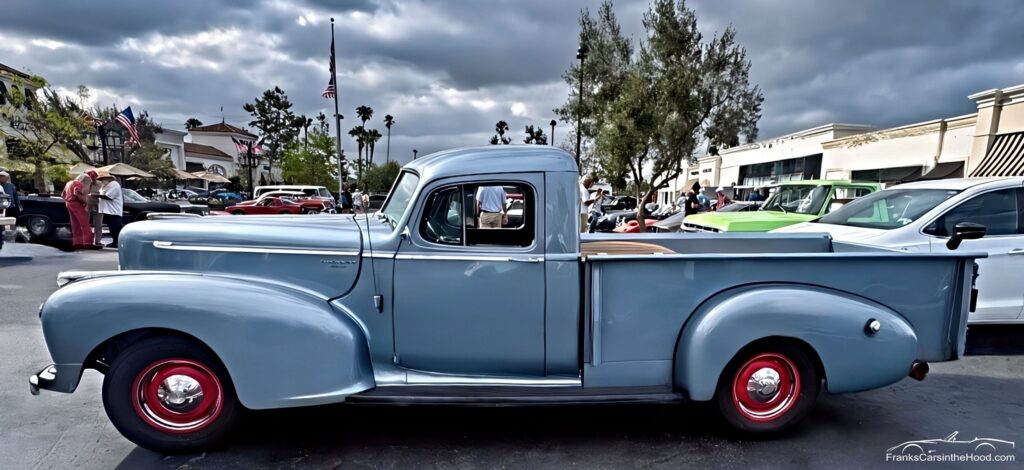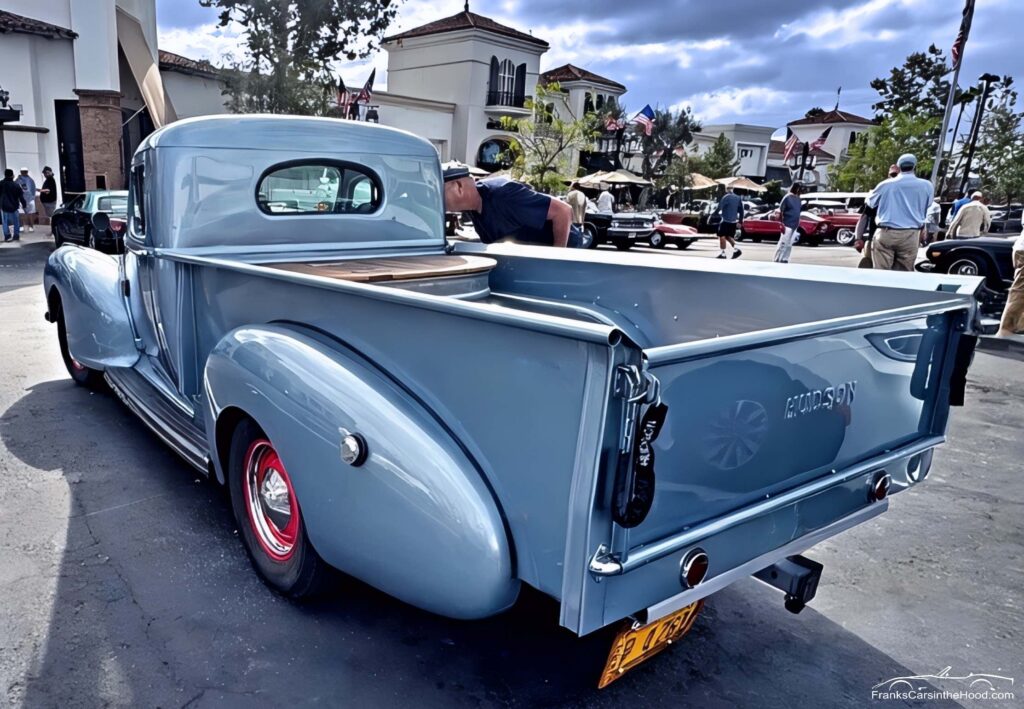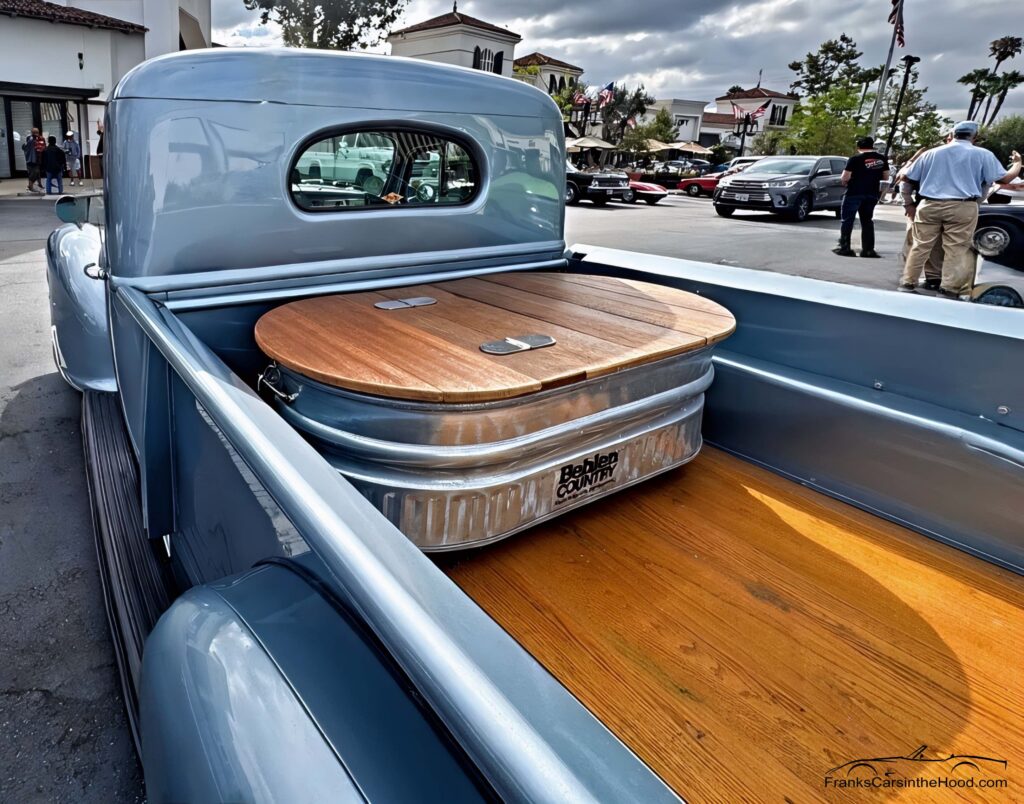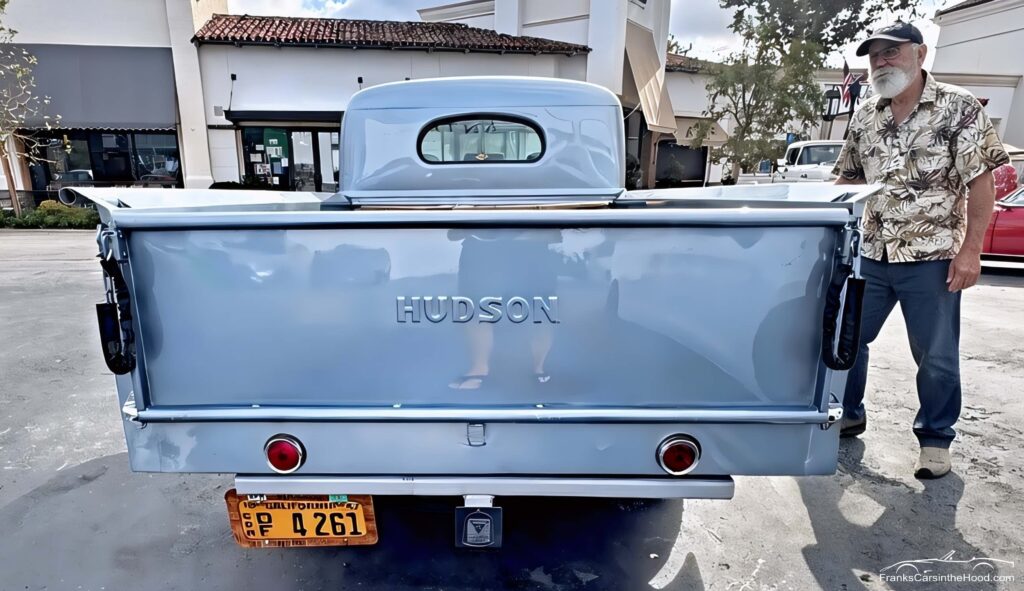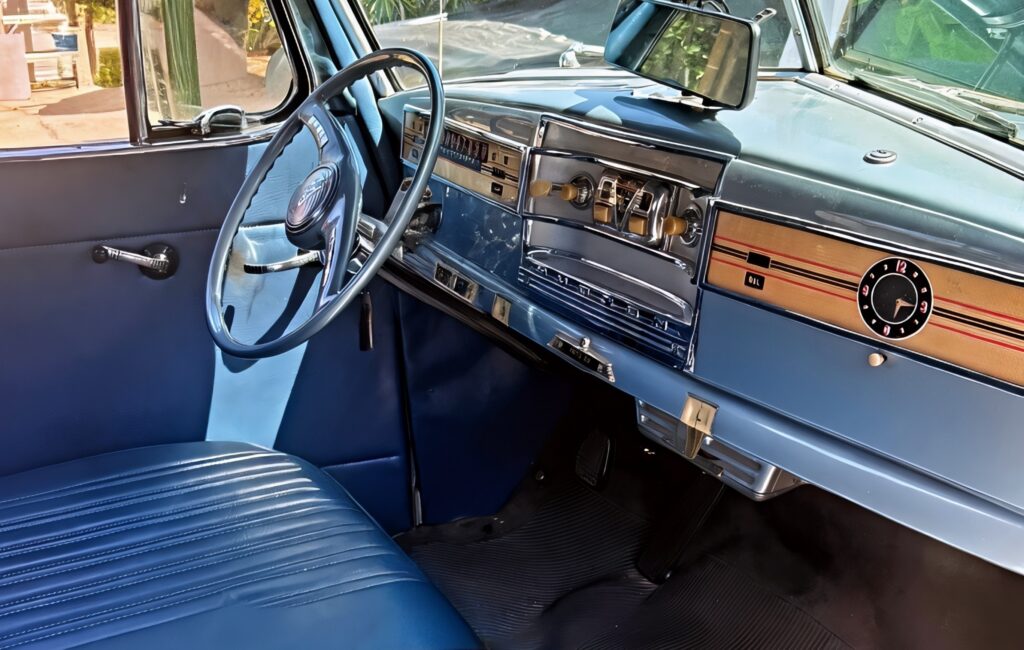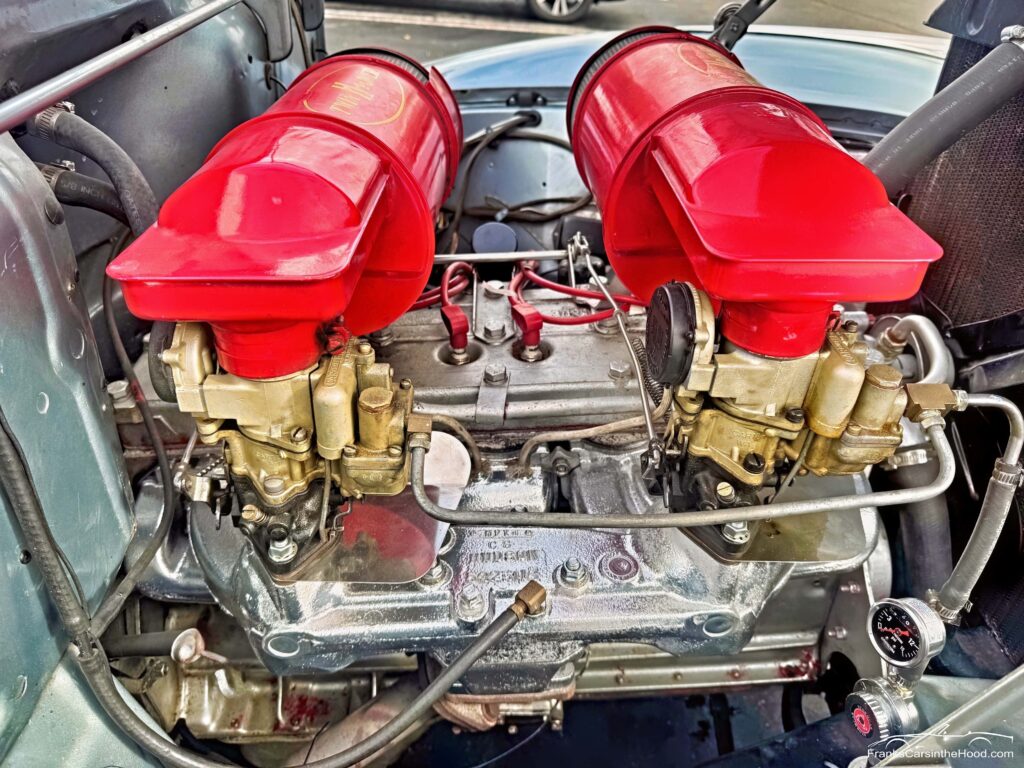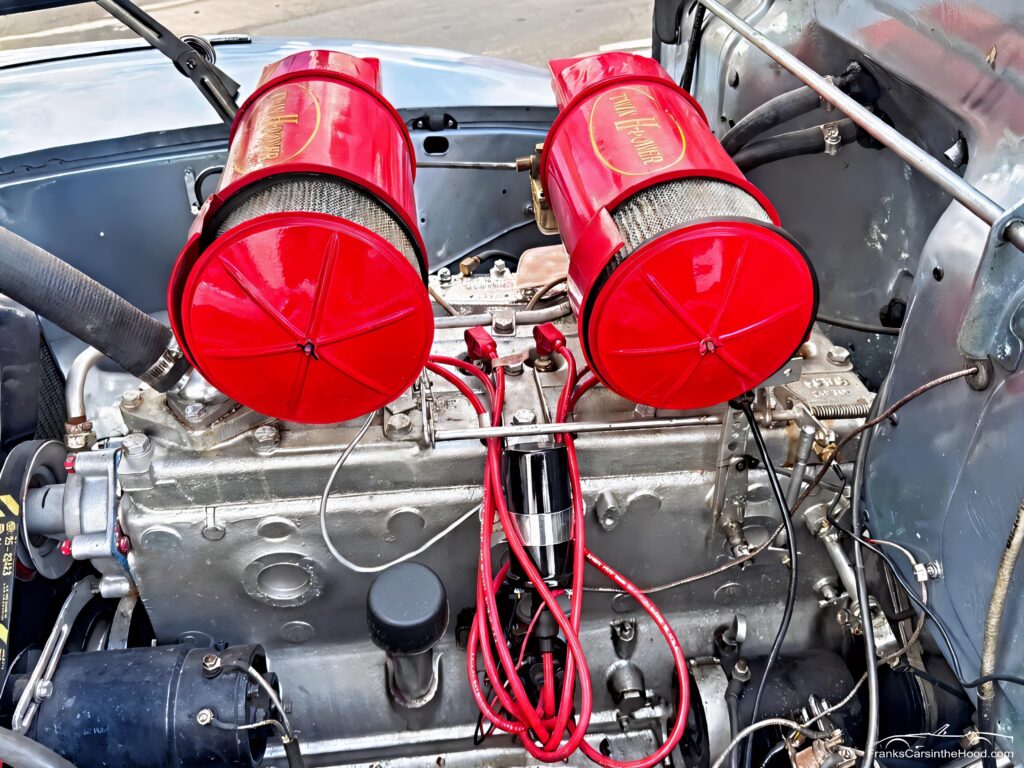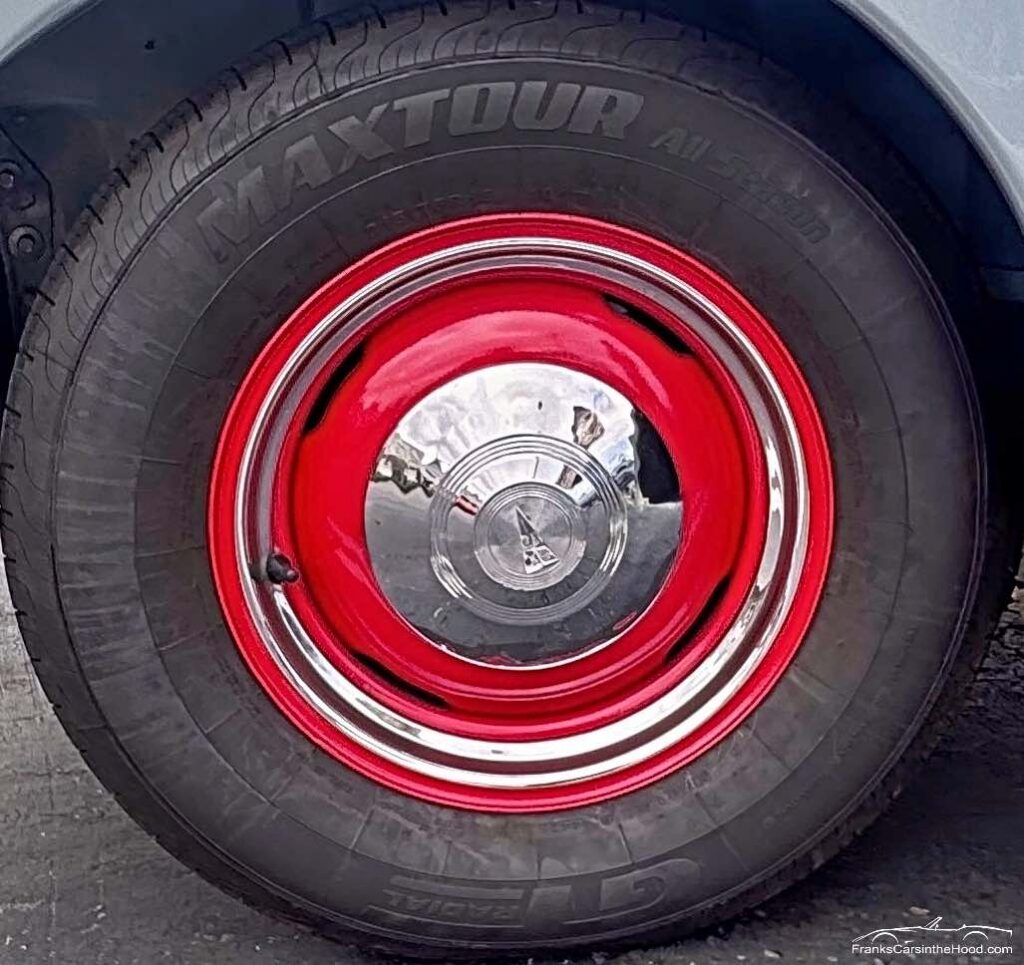
Today’s truck is a 1947 Hudson Super Six Pickup (Big Boy) owned by Dennis Ramsey, which I photographed at the Million Dollar Breakfast Club Cars & Coffee in Marina del Rey, California. Finished in (paint color) with a (interior color) interior, it is powered by an approximately 225-horsepower, 308-cu in Hudson inline six-cylinder engine with Twin H-Power induction. Power is sent to the rear wheels through a four-speed Dual-Range Hydra-Matic automatic transmission and a Mopar 8¾-inch rear axle with a 2.76:1 gear ratio. Front disc brakes and rear drum brakes provide the stopping power, while Hudson’s independent Auto-Poise front suspension and heavy-duty rear leaf springs provide handling and ride quality that were well ahead of most pickups of the era.
Hudson’s story began in Detroit, Michigan, in 1909 when a group of automotive pioneers, led by Roy D. Chapin and Howard E. Coffin, secured financial backing from department store entrepreneur Joseph L. Hudson, whose name the new company proudly carried. From the beginning, Hudson earned a reputation for innovative engineering rather than simply building another automobile. The company’s introduction of the Super Six engine in 1916 established Hudson as one of America’s leading independent automakers, a reputation built on performance, reliability, and engineering excellence. That same philosophy would eventually find its way into every Hudson vehicle, including the company’s remarkably refined Big Boy Pickup. Following its merger with Nash in 1954, automobiles bearing the Hudson name continued through the 1957 model year before the marque was retired.
Hudson recognized that farmers, tradesmen, and small businesses needed dependable commercial vehicles as much as they needed passenger cars. Beginning in the 1920s, the company entered the light-truck market, offering commercial vehicles under the Essex, Dover, Terraplane, Hudson Terraplane, and eventually Hudson names. When production resumed after World War II, Hudson introduced its new ¾-ton Big Boy Pickup for 1946.
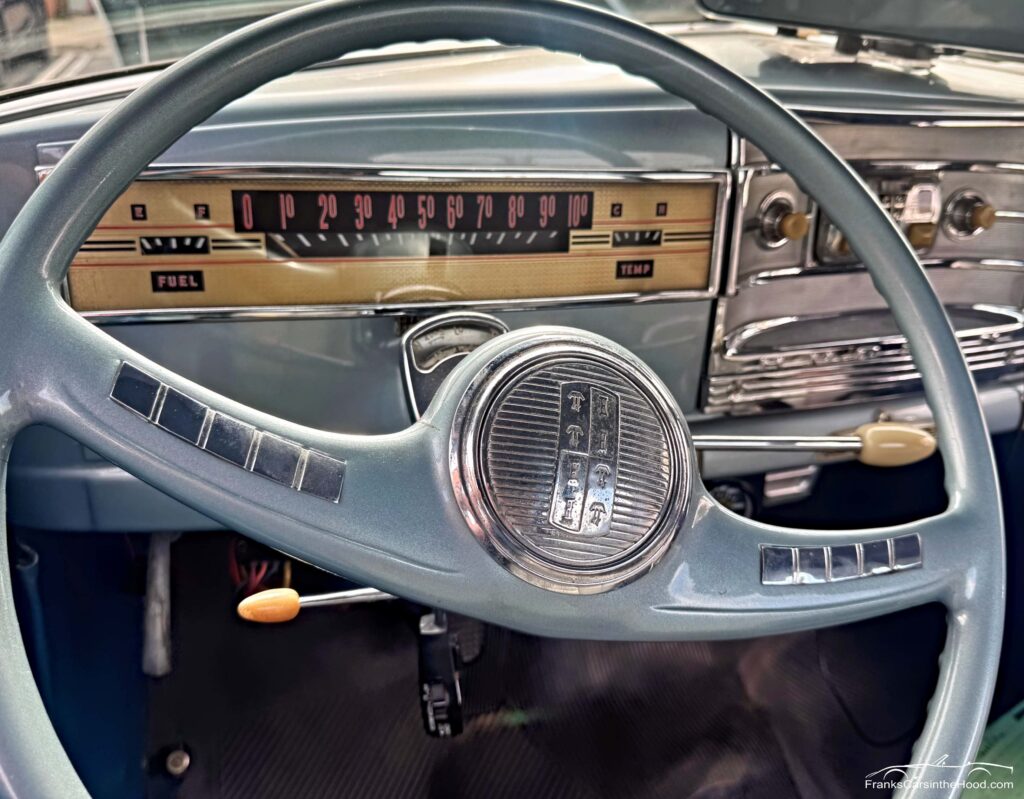
The Big Boy was much more than a conventional work truck. Its distinctive styling originated with Betty Thatcher Oros, who became the first full-time female automotive designer in the United States when she joined Hudson in 1939. Oros conceived the truck’s design that same year, and although minor updates followed for the 1946 and 1947 models, the truck remained remarkably faithful to her original vision. While retaining the rugged ¾-ton chassis and hauling capability commercial buyers expected, Hudson gave the pickup an unusually refined character with its Auto-Poise independent front suspension, an attractively styled passenger car dashboard, and available passenger-car amenities that included a Weather-Master heater, Zenith radio, and a 30-hour glovebox clock. At a time when most pickups were built strictly as utilitarian work vehicles, it demonstrated that a hardworking truck could also deliver comfort, style, and a more enjoyable driving experience.
The 1947 model marked the end of an era for Hudson pickups. Approximately 2,917 were built during the model year before Hudson permanently ended truck production to concentrate on its passenger car business. Today, surviving examples are rarely seen, making Dennis Ramsey’s beautifully restored Hudson an especially fitting ambassador for Hudson’s final chapter in the pickup market.
Dennis Ramsey’s Hudson is a wonderful example of Hudson’s innovative approach to building a pickup. The restoration was completed in 2004 by Randy and Russ Maas of 21st Century Hudson, nationally recognized Hudson restoration specialists. Dennis discovered the truck on Facebook Marketplace late in 2025 and, after patiently waiting for the seller to resolve a persistent running problem, purchased it at the beginning of 2026, becoming the latest caretaker of this remarkable piece of Hudson history.
Although the truck had been beautifully restored, it still had one lingering problem. The previous owner struggled to keep it running properly once the engine reached operating temperature, believing the trouble was somewhere in the carburetors. After bringing the truck home, Dennis began tracing the problem himself. Crawling beneath the truck, he discovered that the intake manifold was cracked in several places. As the engine warmed, the cracks expanded, allowing air to enter the intake and causing the engine to run poorly. Dennis contacted Russ Maas, who located a new old stock replacement manifold. After having it ceramic coated inside and out for both durability and appearance, Dennis installed it, finally restoring the truck to the smooth, dependable performance Hudson engineers had intended.
Lift the hood and another chapter of Hudson history comes into view. During the restoration, the truck’s original 212 cu in six-cylinder engine was replaced with Hudson’s legendary 308 cu in engine. The drivetrain remains entirely Hudson in character, giving the pickup the performance of the company’s celebrated Hornet models. It is a thoughtful period-correct upgrade that feels less like a modification and more like the truck Hudson might have built had the 308 engine been available in 1947.
The 308 cu in Twin H-Power engine represents the pinnacle of Hudson’s flathead six-cylinder development. Introduced in the early 1950s, it earned its reputation through a remarkable combination of power, durability, and racing success. Installed in the Hudson Hornet, the 308 helped establish Hudson as one of America’s premier performance marques, powering the company to more than 80 NASCAR Grand National victories between 1951 and 1954. Seeing that legendary engine under the hood of the pickup feels perfectly at home, giving Hudson’s final pickup the heart of Hudson’s most celebrated automobile.
Dennis has always been drawn to automobiles that stand apart from the crowd. Since high school, he has owned an eclectic mix of vehicles, beginning with a Sunbeam Imp and later a variety of British sports cars, including MG Midgets, an MGB, and a Triumph TR6. Today, he also owns a 1964 Dodge Dart convertible. For Dennis, the enjoyment has never been about owning what was popular at the time. It’s about preserving and driving vehicles with character and history.
When Dennis discovered the Hudson on Facebook Marketplace, he knew he had found something special. After years of owning distinctive automobiles, the Hudson offered everything he was looking for, rarity, engineering, and the opportunity to preserve a unique piece of automotive history. Rather than letting his savings sit in the bank, Dennis decided he would rather enjoy driving this unique Hudson, one that few people have ever seen, much less driven.
Nearly eight decades after it left the factory, Dennis Ramsey’s 1947 Hudson Super Six Pickup continues to fulfill Hudson’s vision of building a pickup that combined the practicality of a work truck with the comfort and amenities of a passenger car. Thanks to its careful restoration, legendary Twin H-Power engine, and Dennis’s commitment to preserving its heritage, this rare Hudson remains a rolling reminder of a time when one independent automaker dared to build a pickup unlike any other. Whether it’s attending Hudson or orphan car shows, Cars & Coffee events, or meeting up with fellow enthusiasts for a leisurely drive up the coast for breakfast or lunch, Dennis’s Big Boy continues to introduce new generations to one of Hudson’s distinctive creations.
Thank you for riding along with me and for being part of the Frank’s Cars in the Hood community.
Frank